
A programming language designed for LLMs to write, not humans.
From the Latin veritas — truth. In Vera, verification is a first-class citizen.
From the Latin veritas — truth. In Vera, verification is a first-class citizen.
Programming languages have always co-evolved with their users. Assembly emerged from hardware constraints. C from operating systems. Python from productivity needs. If models become the primary authors of code, it follows that languages should adapt to that too.
The biggest problem models face isn't syntax — it's coherence over scale. Models are pattern matchers optimising for local plausibility, not architects holding the entire system in mind.
The empirical literature shows models are particularly vulnerable to naming-related errors: choosing misleading names, reusing names incorrectly, and losing track of which name refers to which value. Vera addresses this by making everything explicit and verifiable.
The model doesn't need to be right. It needs to be checkable. Names are replaced by structural references. Contracts are mandatory. Effects are typed. Every function is a specification the compiler verifies against its implementation.
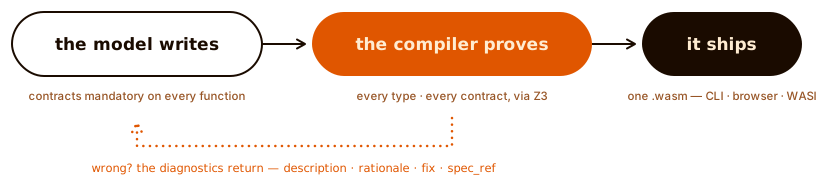
For deeper questions about the design — why no variable names, what gets verified, how Vera compares to Dafny, Lean, and Koka — see the FAQ.
Nothing is implicit. The signature declares types, preconditions, postconditions, and effects. The compiler verifies the contract via SMT solver. A zero divisor the verifier can witness is a compile error (E526), not a runtime crash.
public fn safe_divide(@Int, @Int -> @Int)
  requires(@Int.1 != 0)
  ensures(@Int.result == @Int.0 / @Int.1)
  effects(pure)
{
  @Int.0 / @Int.1
}
public fn fizzbuzz(@Nat -> @String)
  requires(true)
  ensures(true)
  effects(pure)
{
  if @Nat.0 % 15 == 0 then {
    "FizzBuzz"
  } else {
    if @Nat.0 % 3 == 0 then {
      "Fizz"
    } else {
      if @Nat.0 % 5 == 0 then {
        "Buzz"
      } else {
        "\(@Nat.0)"
      }
    }
  }
}
public fn classify_sentiment(@String -> @Result<String, String>)
  requires(string_length(@String.0) > 0)
  ensures(true)
  effects(<Inference>)
{
  let @String = string_concat("Classify as Positive, Negative, or Neutral: ", @String.0);
  Inference.complete(@String.0)
}
public fn research_topic(@String -> @Result<String, String>)
  requires(string_length(@String.0) > 0)
  ensures(true)
  effects(<Http, Inference>)
{
  let @String = url_encode(@String.0);
  let @Result<String, String> = Http.get(string_concat("https://api.duckduckgo.com/?format=json&q=", @String.0));
  match @Result<String, String>.0 {
    Ok(@String) -> Inference.complete(string_concat("Summarise this in one paragraph:\n\n", @String.0)),
    Err(@String) -> Err(@String.0)
  }
}
public fn find_user(@String -> @Result<Array<Array<Option<String>>>, String>)
  requires(string_length(@String.0) > 0)
  ensures(true)
  effects(<DB>)
{
  DB.query("SELECT name, email FROM users WHERE name = ?", [Some(@String.0)])
}
[E001] Error at main.vera, line 14, column 1:

    {
    ^

  Function is missing its contract block. Every function in Vera must declare
  requires(), ensures(), and effects() clauses between the signature and the body.

  Vera requires all functions to have explicit contracts so that every function's
  behaviour is mechanically checkable.

  Fix:

    Add a contract block after the signature:

      private fn example(@Int -> @Int)
        requires(true)
        ensures(@Int.result >= 0)
        effects(pure)
      {
        ...
      }

  See: Chapter 5, Section 5.2 "Function Declaration Syntax"
Six of nine frontier models write 100% correct Vera — a language none of them has ever seen before.

A 60-problem benchmark across 5 difficulty tiers — pure arithmetic, strings and arrays, ADTs and exhaustive matching, recursion with termination proofs, multi-function effect propagation. Nine models, three providers, four modes each: Vera written against a full specification, Vera written from a plain English description with the model authoring its own contracts, and the same problems in Python and TypeScript. The table shows three of the four, and reports % solved: the model wrote code, it compiled, it ran, and the output matched. A refusal, a compile failure, a crash and a wrong answer all count alike as not solved.
| Model | Vera | Python | TypeScript |
|---|---|---|---|
| Claude Fable 5 ceiling | 100% | 97% | 97% |
| GPT-5.6 Sol (pro) ceiling | 100% | 95% | 100% |
| Claude Opus 5 flagship | 100% | 95% | 100% |
| Claude Opus 4.8 flagship | 93% | 98% | 100% |
| GPT-5.6 Sol flagship | 98% | 95% | 100% |
| Kimi K3 flagship | 100% | 100% | 100% |
| Claude Sonnet 5 workhorse | 97% | 98% | 100% |
| GPT-5.6 Terra workhorse | 100% | 95% | 100% |
| Kimi K2.6 workhorse | 100% | 97% | 100% |
Frontier models now write Vera as well as they write the languages they were trained on. Vera has the highest score, or level with it, for six of the nine models.
Mandatory contracts and typed slot references appear to provide enough structure to compensate for zero training data. Every successful program came from a single skill file in context, written by a model that had never seen the language before.
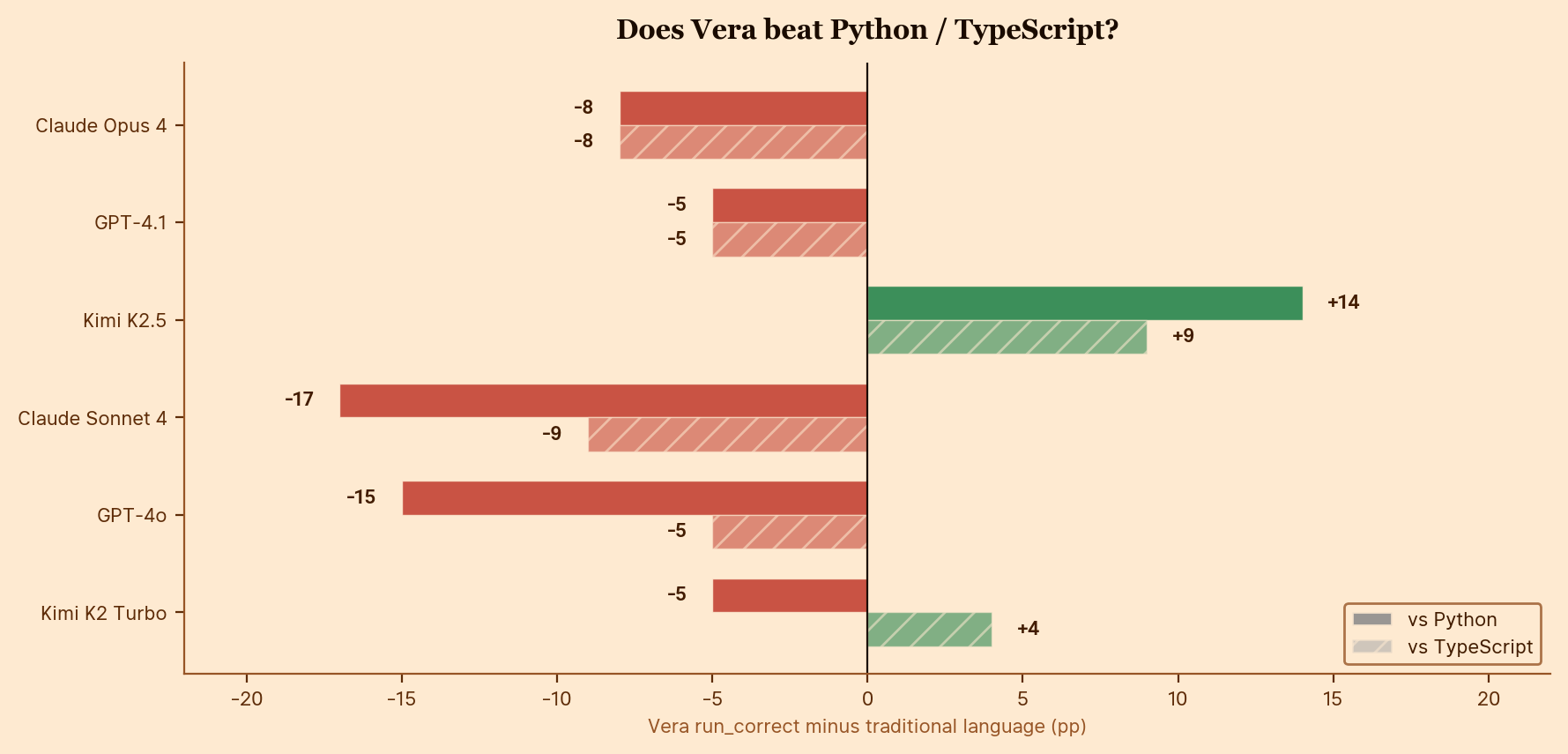
The difference between the Python and TypeScript results is probably not random. Python is dynamically typed, so a type error surfaces when the code runs; TypeScript is statically typed and rejects the same error before anything runs. Vera sits with TypeScript but goes further, making requires, ensures and effects mandatory on every function and replacing variable names with typed slot references. Sort the three languages by how much they constrain the model rather than by how much of them it has read, and the ordering stops looking accidental: the two languages that constrain the model finish ahead of the one that doesn't.
TypeScript earns its results due to its inclusion in model training data. Vera earns very nearly the same results without that. Whatever familiarity is buying TypeScript, the additional constraints Vera provides appear to be supplying by other means.
It's still early days. The benchmark is just a single run per model, no pass@k; and with just sixty problems each problem is worth just under two percentage points, so most of the gaps above are only one or two problems wide. However, it looks like language design can, at least sometimes, outweigh sheer volume of training data. Which, if you're in the business of generating code at any scale, is a reasonably interesting thing to be true.
Results from VeraBench v0.0.18 against Vera v0.1.8. Inspired by HumanEval, MBPP, and DafnyBench.
Design principles
vera fmt settles it.@T.n), not arbitrary names.Key features
@T.n) replace variable names: @Int.0 is the most-recent Int binding, @Int.1 the one before. The whole class of naming hallucinations is removed at the language level, not caught after the fact.<DB> effect accepts only a literal query string — built from string literals, never spliced from a runtime value. Interpolating user input into SQL is a compile-time error (E207); every value flows through a ? placeholder instead. Injection safety stops being a discipline you remember and becomes one the compiler enforces.n”.Inference.complete is an algebraic effect — typed, contract-verifiable, host-backed. Anthropic, OpenAI, Moonshot, Mistral, xAI, DeepSeek.<Async> effect and compose with the rest of the effect system.<HttpServer> effect marks a total handle(Request -> Response). The accept loop lives in the host, so every handler contract is an ordinary proof obligation. vera serve runs it.vera compile --target wasi-p2 emits a component any stock wasip2 host runs (experimental; IO and Random surface). --world server packages a handler as a wasi:http component for wasmtime serve.Vera compiles to WebAssembly. The same .wasm runs at the command line (via wasmtime) and in the browser (wrapped in a self-contained JS runtime); WASI 0.2 is a separate portable component built from the same source.
$ vera run examples/hello_world.vera
Hello, World!

$ vera run examples/factorial.vera --fn factorial -- 10
3628800
vera run compiles to WASM and executes via wasmtime. --fn picks any public function; arguments follow --.
$ vera compile --target browser \
    examples/hello_world.vera
Browser bundle: examples/hello_world_browser/
  module.wasm
  runtime.mjs
  index.html
Self-contained — no bundler. Serve with any HTTP server (python -m http.server). IO.print writes to the page; every other operation the browser target supports works identically to the CLI, apart from md_parse, whose two hand-written implementations still disagree on a few shapes the §9.7.3 subset does not pin (#1301). json_stringify and md_render reach that identity by emitting a canonical form the specification states (§9.7.1, §9.7.3) rather than by the hosts happening to agree, and json_parse by accepting the domain §9.7.1 states — RFC 8259-valid text that decodes to finite numbers and strings of Unicode scalar values — rather than whatever its host parser admits; parity tests check all three against that stated form as well as against each other, on every PR. Note: Inference.complete and every DB operation return an error in the browser — a deliberate platform boundary, since the credentials they need would be readable from page source; reach them through a server-side proxy via Http.
$ vera compile --target wasi-p2 --world server \
    examples/http_server.vera
Compiled (WASI Preview 2 server component
(run with: wasmtime serve <file>)): examples/http_server.wasm

$ wasmtime serve examples/http_server.wasm
Serving HTTP on http://0.0.0.0:8080/
--target wasi-p2 emits a WASI 0.2 component any stock wasip2 host runs — wasmtime run module.wasm needs no flags and no Vera bindings (experimental; the IO and Random surface). --world server packages a handle(Request -> Response) program as a wasi:http component that wasmtime serve runs unmodified.
Python 3.11+. Everything installs into a virtual environment.
# Install the toolchain from PyPI
python -m venv .venv
source .venv/bin/activate
python -m pip install veralang
vera version

# Optional: the language server for editors and agents
python -m pip install "veralang[lsp]"
The wheel ships the compiler and the vera command. For the full environment — the bundled examples, conformance suite, and specification the agent docs teach from — or for compiler development and unreleased changes, install from source.
# Clone and install from source
git clone https://github.com/aallan/vera.git
cd vera
python -m venv .venv
source .venv/bin/activate
pip install -e ".[dev]"

# Check, verify, run, compile the bundled examples
vera check examples/absolute_value.vera
vera verify examples/safe_divide.vera
vera run examples/hello_world.vera
vera compile --target browser examples/hello_world.vera
There is out of the box support for three editors. Vera Language for Visual Studio Code is the fullest — install it from the Marketplace or with code --install-extension veralang.vera-language, and it starts vera lsp automatically for .vera files alongside syntax highlighting and language configuration. A Vim package covers Vim 8+ and Neovim, and a Vera .tmbundle covers Sublime Text and other editors that read TextMate grammars.
Live proof-aware diagnostics, hover, slot go-to-definition, and typed-hole completion come from the language server. The source install above (.[dev]) already includes it; on the PyPI route add it with python -m pip install "veralang[lsp]", or use pip install -e ".[lsp]" for a lighter source checkout. Any editor with a generic LSP client can point at vera lsp directly.
Every document here has an alternate in markdown, served on the same domain, discoverable through standard <link rel="alternate">, llms.txt, and the Mintlify llms-txt / llms-full-txt conventions.
builtins/effects/errors introspection commands.Claude Code discovers SKILL.md and CLAUDE.md automatically when working inside the repo. For other projects, install the skill manually:
mkdir -p ~/.claude/skills/vera-language
cp /path/to/vera/SKILL.md ~/.claude/skills/vera-language/SKILL.md
For other models: point them at SKILL.md via system prompt, file attachment, or retrieval. It's self-contained and works with any model that reads markdown.
The documents above are how machines read Vera. The language server is how they interrogate it: vera lsp holds a warm, incremental Z3 session between edits, and four custom methods — vera/speculativeEdit, vera/proposeEdit, vera/strengthenContract, vera/addEffect — let an agent learn whether an edit keeps, breaks, or strengthens a program's proofs before committing it, then apply it only through the verification gate.
# vera/speculativeEdit — the proof delta for an in-memory edit
{
  "ok": true,
  "proof_delta": {
    "newly_discharged": ["..."],
    "newly_undischarged": [],
    "timed_out": [],
    "removed": [],
    "unchanged": 11
  },
  "diagnostics": 0
}
A complete compiler with 164 built-in functions, ten algebraic effects (IO, Http, HttpServer, State, Exceptions, Async, Inference, DB, Random, Diverge), contract-driven testing via Z3, a language server with agent-facing proof deltas, and a 14-chapter specification. A 244-program conformance suite and 43 worked examples are validated against the spec on every pull request. All of it is developed openly on GitHub and released under the MIT licence.
